Budget initiatives to help aspiring homeowners

In May, the Federal Government delivered the 2024-25 budget. It included several measures such as a $300 energy bill rebate and rent assistance aimed at easing the cost-of-living pressures on Australians. Meanwhile, with the government’s stage 3 tax cuts coming into effect from July 1, some aspiring homeowners may see their borrowing capacity grow, along with their net income. 


Let’s take a look at some of the government initiatives that may help you get a leg up on the property ladder sooner rather than later.

Help to Buy Scheme funding

In the May Budget, the government allocated $5.5 billion towards its shared equity Help to Buy Scheme in 2024-25 for aspiring homebuyers on low and moderate incomes. 

Under the scheme, the government will provide an equity contribution of up to 40% of the purchase price for new homes and 30% of the price of existing homes. 

To be eligible, you need to: 

  • Be an Australian citizen and at least 18 years of age 
  • Earn $90,000 or less as a single or $120,000 or less as a couple 
  • Live in the property 
  • Not own any other land or property in Australia or overseas 
  • Have saved a deposit of at least 2 per cent and be able to finance the remainder through a participating lender 
  • Be able to pay for the upfront and ongoing costs 
  • Be buying a property that falls under the price cap for your region.

Housing Australia boost

The government increased its line of credit to Housing Australia by $3 billion, and Housing Australia’s liability cap by $2.5 billion. Housing Australia administers the Home Guarantee Scheme, which encompasses the First Home Guarantee (FHBG).

Under the FHBG (which the government has previously indicated will be available until 30 June 2025), part of an eligible home buyer’s home loan from a participating lender is guaranteed by Housing Australia.


Homebuyers can purchase a home with as little as 5% deposit without paying Lenders Mortgage Insurance. 


To apply for the FHBG, homebuyers must be: 

  • Applying as an individual or two joint applicants 
  • Australian citizens or permanent residents at the time they enter the loan
  • At least 18 years of age
  • Earning up to $125,000 for individuals or $200,000 for joint applicants
  • Intending to live in the purchased property 
  • First home buyers or previous homeowners who haven’t owned or had an interest in a real property in Australia (this includes owning land only) in the past ten years.


More information around eligibly and price caps is available here.


The Regional First Home Buyer Guarantee (RFHBG) and Family Home Guarantee (FHG) are also administered by Housing Australia.


Homes for Australia Plan investment

The 2024-25 Budget included $6.2 billion in new investment to build more homes across Australia. The plan is to build 1.2 million new homes over five years from mid-2024.


The government said among other initiatives, the money would go towards turbocharging construction, with a $1 billion boost for states and territories to build the roads, sewers, energy, water and community infrastructure needed for new homes, and additional social housing. 


Up to $1.9 billion in concessional finance will go to community housing providers and charities to support delivery of the 40,000 social and affordable homes under the Housing Australia Future Fund and National Housing Accord. 


Tax cuts

From July 1, the government’s stage 3 tax cuts come into effect, as follows:
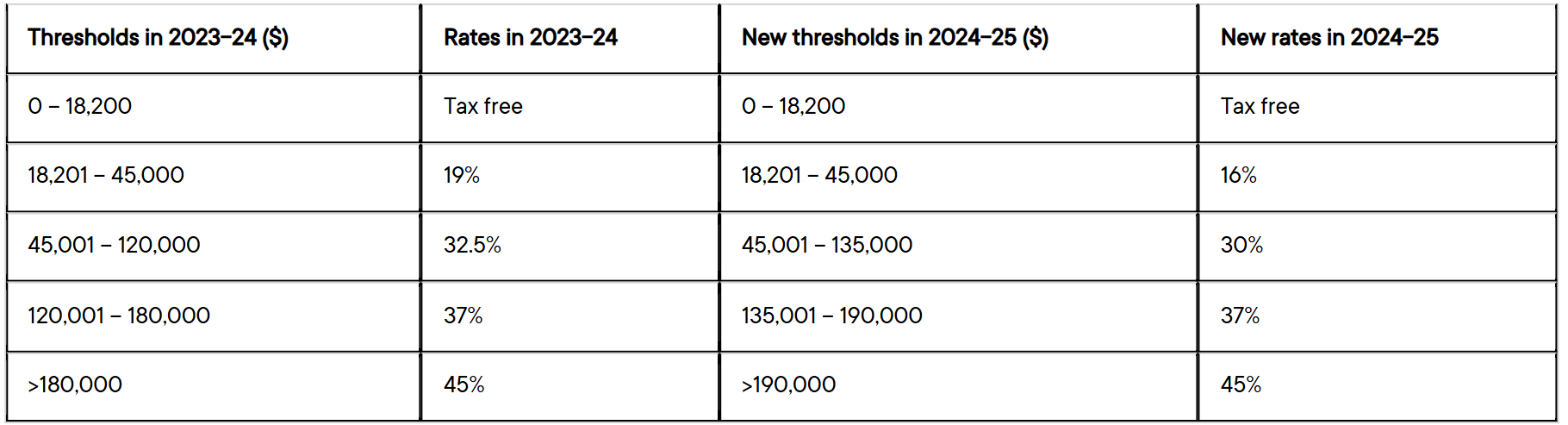
As a result of the tax cuts, some purchasers will see their borrowing capacity increase as their take home pay rises, meaning they will have more options when seeking finance for a home. For an idea of your borrowing capacity, get in touch and we’ll crunch the numbers.


Like to discuss your finance options?

If you’re planning a property purchase, let’s chat. We can run through whether you are eligible for any government incentives and explain your finance options.


Get in touch today.


Source: Finance Focus


August 20, 2026
The Federal Government’s negative gearing and Capital Gains Tax (CGT) reforms represents a significant shift in how future property investments will be treated for tax purposes. For investors considering their next purchase, the changes may influence everything from the type of property they buy to how they assess cash flow and long-term returns. Legislated, many investors are reassessing their property purchasing plans and strategies. The core reforms have now passed Parliament, although some of the more detailed implementation rules are still being finalised ahead of their commencement. If you’re looking to buy an investment property down the track, here’s what you need to know about the reforms and how they change the playing field. What is changing? On 12 May, Treasurer Jim Chalmers handed down the Federal Budget , which included major changes to negative gearing and CGT rules. From 1 July 2027: Negative gearing for residential property investments will be limited to new builds. The 50 per cent CGT discount will be replaced with cost base indexation and a 30 per cent minimum tax rate on capital gains. Properties held before the announcement (7:30pm AEST 12 May 2026) will be exempt from the negative gearing changes, while the CGT reforms will only apply to gains accruing after 1 July 2027. How have the reforms affected the market and investors? When the changes were announced, Australia’s property market had already been cooling, driven by a combination of cash rate hikes, housing affordability constraints, the Middle East conflict, and cost-of-living pressures. But the Federal Budget reforms dampened the market even further, with auction clearance rates slipping to levels worse than during the pandemic, and investor confidence dropping. One survey of more than 1,400 Australian investors found that more than 80% believed residential investment property had become less attractive following the 2026 Federal Budget changes. At the same time, 51.5% said they planned to hold their existing investments and wait to see how the proposed legislation evolves. Overall, the survey offers a useful snapshot of investor sentiment, although it should not be taken as representative of every Australian property investor. Key shifts in strategy Since the announcement, there have been early signs that some investors are reconsidering where and how they invest, although it is too soon to say how the reforms will reshape the broader property market over the long term. New builds could attract more attention With negative gearing limited to new builds from 1 July 2027, there are signs that some investors are pivoting towards newly constructed properties. Data from property fund manager Oliver Hume shows the proportion of new-build sales to investors in Victoria has risen above 40 per cent for the first time since December 2024, for example. Experts say investors will likely switch to new units or houses on the outer city fringes, while suburbs in the middle of cities could experience a decrease in stock, potentially resulting in higher rents . Holding or grandfathering existing assets Investors with established properties purchased before 12 May 2026 may choose to retain those properties, as they are exempt from the negative gearing reforms and can continue to access the existing tax treatment that applies to grandfathered properties. These investors can keep negative gearing the property against their wage income and retain the full benefits until they sell. Cash flow could become an even bigger consideration Historically, negative gearing enabled investors to offset losses on established investment properties against their taxable income. But under the changes , investors purchasing established properties would no longer receive immediate tax relief on those losses. The changes may prompt some investors to focus more heavily on rental yield , cash flow and long-term returns when assessing investment opportunities. As a result, positively geared properties could become more attractive relative to investments that rely heavily on tax concessions to support returns. Some may also look for properties with the potential to transition to positive gearing over time as rental income grows. What about the changes to SMSF borrowing? In addition to the CGT and negative gearing reforms, there are new rules around self-managed super fund (SMSF) borrowing. From 10 August 2026, SMSFs can no longer use Limited Recourse Borrowing Arrangements (LRBAs) to buy residential property. Current LRBAs are grandfathered. SMSFs can still purchase residential property outright using cash , and LRBAs can be used to acquire business real property. The changes have been met with mixed reviews among investors, and some critics questioning whether it would make it harder for Australians to build retirement wealth . Some experts also believe that the changes could increase the appeal of commercial property among SMSF investors, although SMSF property investment can involve complex lending, tax and superannuation requirements, so specialist financial, legal and tax advice is particularly important. Considering an investment property purchase? The changes in the budget mean investors may need to think differently about the type of property they purchase, its cash flow and how the investment fits within their broader financial plans. While we can’t provide tax or financial advice, we can help you understand the lending side of the equation. We can review your borrowing capacity, compare suitable loan options and help you understand how different property and loan scenarios could affect your repayments and overall finance structure. If you’re considering your next investment property, get in touch! We can help you explore your finance options so you can make your next move with a clearer understanding.
July 20, 2026
After years of fierce competition, fast-rising prices and crowded auction weekends, the market is beginning to show signs of a shift. More properties are being listed for sale, homes are taking longer to sell, and buyers are becoming increasingly selective about what they’re willing to pay.